
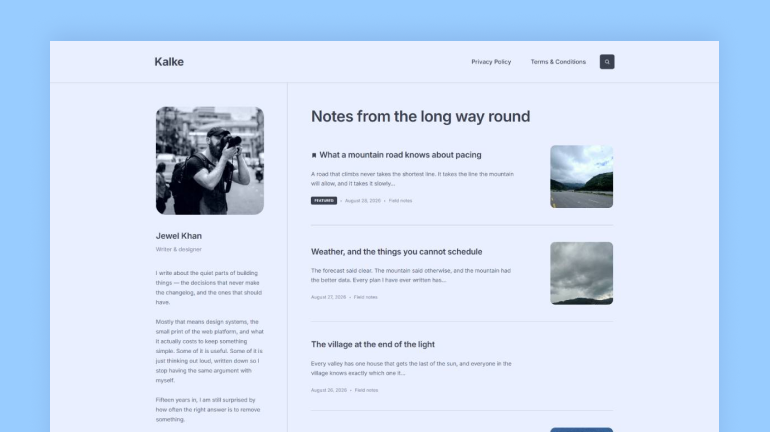
Most blog themes are built to display posts. Kalke is built to be read. It puts a twelve-column reading grid under your writing, gives you an author rail that introduces you without shouting, and then gets out of the way — so the longest thing on the page is the sentence you wrote, not the interface around it.
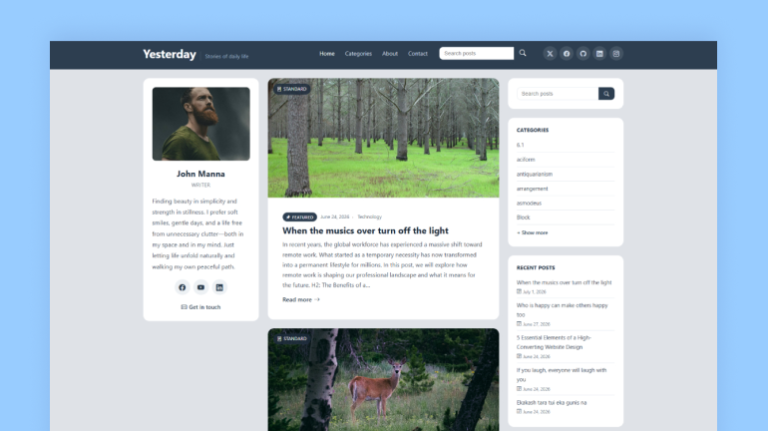
The blog index pairs your post list with a standing author rail: a portrait, your name and role, a short biography, a signature, a contact link and social icons. It ships as an editable pattern, so you change it once in the Site Editor and it stays yours. Below it, posts run in a calm vertical rhythm — title, two lines of excerpt, date, category, and a featured image when there is one. Posts without an image sit just as comfortably as posts with one.
Every post format is styled, not just supported: asides, links, quotes, images, galleries, audio, video and status updates each get their own small icon in the meta row. Chat-format posts render as alternating message bubbles. Sticky posts carry a bookmark mark and a Featured badge. Posts split with a page break get their navigation back, which the block editor otherwise drops. Long category and tag lists in the sidebar collapse behind a Show more toggle instead of running for screens.
Blog index, single post with sidebar, page, archive, search results and a 404 — plus two full-width variants, Post — full width and Page — full width, selectable per post when a piece deserves the whole measure.
The palette is eight tokens in theme.json, so recolouring in Global Styles re-themes every component at once. Solid controls — buttons, badges, icon buttons, quote rules — use one dark tone; links and hover states use a separate chromatic accent. Keeping those apart is what lets a link still read as a link. Body copy clears 4.5:1 and white-on-button clears 10:1.
Inter for text and interface, Grape Nuts for the signature — both bundled locally. Kalke makes no external requests at all, so nothing about your readers leaves your server.
Visible focus rings on every control, a skip link, a keyboard-navigable menu with a proper focus trap on mobile, and empty states that hide themselves rather than leaving bordered boxes and orphaned headings on a new site.
.pot included · Sass sources included
Comments (0)